For concrete subcontractors
Concrete contractor software built around the pour date.
A pour date is the one date on a commercial job that genuinely cannot move. Everything upstream — subgrade, forms, rebar, embeds, inspection — has to be right by 5am, and everything downstream depends on the pour going in. SubMark keeps the crew hours, the ready-mix POs and the supplier invoices against the job as they land, and keeps the paperwork that pays for the rained-out day.
14-day free trial, no card needed. Sign up from here and concrete is already selected when you pick your trade. See pricing →
- Crew hours against the job as they are logged
- Ready-mix POs and invoices against the job
- Weather and pump delays logged the same day
What actually goes wrong on a commercial concrete job.
A lost pour day costs you three ways and gets logged as none.
It rains at 4am. The crew is already called out, the pump is scheduled, the ready-mix is batched. You pay the show-up time, you may eat a short-load or cancellation charge, and the pour moves into a week that was already full. Every piece of that is recoverable or at least arguable, and almost none of it gets written down. A daily log with the weather, the crew who showed up and the hours, made that morning, is the whole difference.
You find out what the concrete cost weeks after it cured.
Yards get ordered the day before, adjusted on the truck, and short-loaded when the forms take less than the takeoff said. The supplier invoice lands three weeks later with overtime, wash-out and short-load charges on it. By then the placement is finished and nobody can say whether you went over. Tie the ready-mix PO and the supplier invoice to the job and the gap between what you committed and what you were charged closes while you can still do something about it.
Your pour is gated by other people’s work.
Pre-pour inspection means rebar right, embeds set, sleeves and conduit in from the MEP trades, and the inspector on site. If the electrician’s sleeves are missing you either pour around them or you stand down — and both are extra work caused by someone else. Raised as a dated change event with photos the morning it happens, that is a claim. Remembered at closeout, it is a story.
Forms are capital, not material.
Panels, ties and shoring get used, stripped, cleaned and used again across placements all year. Costing them like ready-mix — consumed once, charged to one line — makes every early placement look expensive and every later one look free. Tracking form material as a purchase against the job — and, with phase tracking switched on in Settings, forming and stripping labor on their own phase — is what makes the real cost of a placement visible.
Before you mobilize
The 4 things concrete subs settle with the GC before mobilizing.
What is approved, where your scope stops, what has to be true before you start, and how you get at the work. Every one of them turns into a change order three weeks in if nobody writes the answer down — and the answer is worth nothing if it only lives in one PM’s inbox.
In the pack
Switch on Pre-Construction Review and these 4 questions are already the list, worded the way concrete subs ask them.
- Confirm the approved mix designs, finishes and curing requirements
- Confirm the subgrade, formwork and reinforcement inspection sequence
- Confirm embeds, sleeves and layout from the other trades before each pour
- Confirm placement access, weather limits and the pour dates
Tick them off job by job, with your own note on each. The note is your answer — the pack ships the question and leaves the answer to you.
Pre-Construction Review is an opt-in module — it is not one of the eight switched on at setup. Turn it on in Settings and the list is already there in concrete terms, with no upgrade and no setup call. Edit it once and it applies to every job; the tick and the note stay with the job it was asked on. See every module →
The concrete job, placement by placement.
Forming, reinforcement, placing and finishing are different crews with different rates, and a placement runs through all of them in about a week. Here is how the work maps to what ships in SubMark.
- 01 Bid & estimate
Takeoff off the S-sheets, yards by element, rebar tonnage, form area, finish schedule and pump access.
Bid Board, Plans & Drawings, Takeoff, Estimating & Proposals
- 02 Submittals & mix design
Mix designs, rebar shop drawings, admixtures and curing compounds approved before the first truck.
Submittals with a material library and merged PDF export
- 03 Layout & subgrade
Control lines, subgrade prep, vapor barrier and base compaction signed off.
Daily Labor Logs with photos, Change Events for anything the soils report missed
- 04 Forming
Panels, ties, bulkheads and shoring set to line and grade by the form carpenters.
Time Clock & Labor Logs, Job Costing for the job’s labor, material and subs
- 05 Reinforcement & embeds
Rebar placed and tied by the rodbusters, then anchor bolts, sleeves, conduit and embeds from every other trade.
Purchase Orders, Change Events for missing or late embeds
- 06 Pre-pour inspection
The inspector walks it. Rebar, embeds and cover all have to pass before anyone calls the batch plant.
Daily Labor Logs as the dated record of the pre-pour walk, Change Events
- 07 Pour
Trucks, pump, vibration and screed — the one day on the schedule that cannot slip.
Daily Labor Logs with weather and hours, Invoices Inbox tying ready-mix cost to the job
- 08 Finishing
Float, trowel, broom or burnish to the specified finish, plus saw-cut joints before they crack.
Daily Labor Logs, Job Costing for the job’s place-and-finish cost
- 09 Cure, strip & clean
Curing compound or blankets, forms stripped and cycled to the next placement, site cleaned.
Crew Scheduling across jobs, Where Workers Are
- 10 Punch & closeout
Patching, grinding, joint fill, test-cylinder results, as-builts and the retainage release.
Schedule of Values & Draw Log, Lien Waiver Tracking, job files for the break reports
Every module named above ships today; the eight below are on from day one, and the rest are a switch in Settings, not an upgrade. The full list is on the product page.
In the pack
These 9 phases load with the Concrete pack the moment you pick it at setup.
They are the phase list your foremen pick from on every daily log, so the hours come back tagged to the part of the job they were spent on.
- 01 Layout
- 02 Sub-Grade Prep
- 03 Forming
- 04 Reinforcement
- 05 Embeds
- 06 Pour
- 07 Finishing
- 08 Curing
- 09 Strip / Cleanup
Rename, reorder or delete any of them in Settings — the pack is a starting point, not a cage.
A concrete schedule of values that bills the way concrete goes in.
Concrete money is roughly a third material and two thirds labor and equipment, and the labor splits across four crews who never work on the same day. These are the kinds of lines a commercial concrete SOV usually needs:
In the pack
Open the SOV builder on a new job and these 5 lines are already in it.
- Forming 25%
- Reinforcement 15%
- Concrete Material 35%
- Place / Finish 20%
- Cure / Strip 5%
What most commercial concrete subs add
- 01 Submittals, mix design & layout
- 02 Subgrade prep & vapor barrier
- 03 Footings & foundations
- 04 Forming — material cycles across placements
- 05 Forming — labor
- 06 Reinforcement — material
- 07 Reinforcement — labor
- 08 Embeds & anchor bolts
- 09 Ready-mix concrete billed by the yard
- 10 Place & finish — slab on grade
- 11 Place & finish — elevated decks
- 12 Pump & equipment
- 13 Curing & joint sealing
- 14 Strip, patch & closeout
Keeping ready-mix on its own line is what lets you reconcile the supplier invoice against something instead of burying it inside a place-and-finish number. Splitting form material from form labor is what stops your first placement from carrying the cost of forms that will be used on nine more.
That longer list is an illustration, not a template — your SOV is negotiated with your GC. SubMark gives you the SOV to build, and tracks every draw, retainage amount and payment against it. It is your record of the job, not a replacement for the GC’s billing system — you submit the draw the way each GC requires and log it here.
Read next
Schedule of values for subcontractors: how to build one that bills clean
How to break out line items so ready-mix, forming and finishing each carry their own money — and so a placement can be billed the month it goes in.
T&M tickets in commercial construction: getting signed, and getting paid
Show-up time on a rained-out pour, and a stand-down for embeds that were never set, are T&M work — what belongs on the ticket and how to get it signed the same day.
Inside SubMark
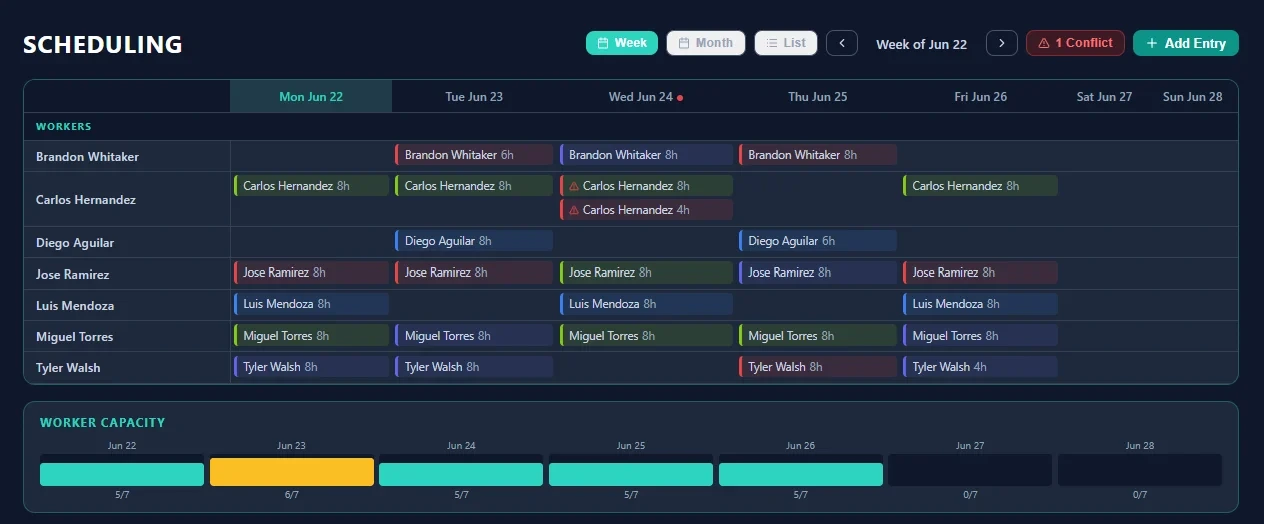
One calendar for every crew on every job.
Form carpenters, rodbusters and a finishing crew across four jobs, with a pour date that cannot move. SubMark schedules every worker in one calendar and flags the conflict before 5am.
On from day one, in every trade’s setup.
Nothing is paywalled by tier. These eight are switched on in every one of the 29 trade packs, concrete included, from the moment you finish setup.
T&M Tags
Field tickets priced off your own rate lists and signed by the GC on the spot.
Change Events
The field logs a scope change with photos the day it happens, then it converts to a CO.
Draw Calendar
Every GC’s billing cutoff and submission method in one calendar, with reminders.
Submittals
Submittal packages with a material library, cover sheets and merged PDF export.
Daily Labor Logs
Weather, narrative, labor, materials and photos, with a submit-and-review workflow.
Timesheets
Weekly rollups with worker signatures and supervisor approval, plus a payroll summary export.
Where Workers Are
A live view of which workers are on which job today.
Safety
Toolbox talks, inspections, incidents, and certification and COI tracking with expiry dates.
Pick Concrete at setup and SubMark loads the concrete pack: the real phase list from layout and subgrade through forming, reinforcement, embeds, pour, finishing, curing and strip; worker types for foremen, finishers, form carpenters, rodbusters and laborers; a material list built around ready-mix, rebar, form panels and curing compound; and a pre-pour inspection on the phase checklist. Anything the pack gets wrong, you change in Settings.
The worker types are already there too — Foreman, Finisher, Form Carpenter, Rodbuster and Laborer — on every worker record and on every daily labor log. The only thing left to enter is your own rates.
Questions
Concrete subcontractors ask us these.
Can I cost a single placement rather than the whole job?
Yes, with Placement Tracking switched on in Settings — it is not on by default. With it on, forming, reinforcement, pour and finishing hours stay distinct and you get budget versus actual per phase while the placement is still fresh, so each pour is something you can compare against the one before it. Left off, job costing still shows labor, material and sub cost for the whole job, grouped by cost type.
How do we document a rained-out pour?
With a daily log made that morning. It carries the weather, the narrative, the crew who showed up, the hours they were paid for, the materials and photos, and it goes through a submit-and-review workflow so it is not just a note on a phone. If the cost is recoverable, that log plus a change event raised the same day is what the conversation runs on.
Can we track ready-mix cost against the supplier invoice?
In dollars, yes. Yards placed are not a quantity SubMark tracks, so be clear-eyed about that. Purchase orders for ready-mix sit against the job, supplier invoices land in the invoices inbox and get coded to it, and connecting QuickBooks Online pulls the bills through (hourly, if you switch auto-pull on) — so what you committed and what you were charged end up next to each other.
Does it handle test cylinders and break results?
Not as a dedicated testing module, and worth being straight about. Break reports and lab results go in the job’s files, and the crew can photograph the cylinder tags onto the daily log for the pour they belong to — daily-log uploads are images. What SubMark does not do is manage a cylinder schedule or chase a lab on your behalf.
Do we still submit our draws through the GC’s system?
Yes. You keep submitting the way each GC requires. SubMark is where your schedule of values lives — footings and foundations, forming and reinforcement split into material and labor, ready-mix, place and finish by slab-on-grade and elevated deck — and where every draw you submit gets logged against it, with retainage held and payment tracked. SubMark does not produce the GC’s paperwork; it keeps your side of the number straight.
Do my field crews cost extra?
No. Field users are free and unlimited, and so are the subs you invite into a job. You pay one company subscription: $249 a month with your first 3 office users included, then $39 a month each. The whole breakdown is on the pricing page.
See it on a concrete job.
Start the trial, confirm concrete on the first screen, and the pack loads your phases, checklists and worker types in your own words. Or take a 30-minute walkthrough with the person who built it, on your kind of jobs, instead of a canned demo script.
14-day free trial, no card needed. See the whole product →
$249/mo for your company, your first 3 office users included, $39/mo each after that. Field crews are free and unlimited. See what's included →
Other trades
Electrical
Gear you pay for months before you bill it, rough-in hours that disappear, and every tenant change landing on your scope.
HVAC / Mechanical
Equipment bought a year before it is billed, shop fab the GC will not pay for, and a closeout that holds your last 10% for six months.
Plumbing
First in the ground and last out of the building — with a quarter of the contract value stuck behind the finish trades.
Drywall & Framing
A third to half the contract spent on board before anything is hung, five finish passes nobody can measure, and three punch walks and a clean-up that are all on you.
Fire Sprinkler
Weeks of hydraulic engineering before you can bill a dollar, and every phase gated behind an inspection you do not schedule.
Glazing & Glass
Custom material you cannot order until you field measure, cannot return once you do, and cannot bill until a water test passes.
Roofing
A tear-off that owns the building until dry-in, rotten deck nobody bid, and a warranty package standing between you and retainage.
Low voltage
Drop counts that move with every furniture plan, cable sitting in a locked IDF for months, and a final 10% that waits on a test report.
Fire alarm
A quarter of the contract behind an acceptance test you do not schedule, retests you never bill, and device counts that move all year.
Painting
The last trade on the schedule, four return trips for other people’s damage, and prep bid against a wall nobody left you.
Flooring
A slab that fails its moisture test, prep bid against a flatness spec nobody hit, and a whole building’s material stored for months.
Masonry
Scaffold that is capital, grout lifts gated by an inspector, and a mock-up panel holding up the whole brick order.
Structural & Misc Steel
Two thirds of the contract is detailing, mill material and shop work, earned before a single piece is erected, and the last five percent is a handrail holding your retainage.
Wood Framing
Fourteen buildings billed as one percentage, a lumber package that is 40% of the contract before a wall goes up, and blocking you owe six other trades that nobody drew.
Excavation & Sitework
The only schedule of values on this site that opens without a single line for product you buy: your contract is production, billed against quantities somebody else surveyed.
Waterproofing
Work that is buried within a week of going in, blamed for every drop of water for the next ten years, and finished with sealants months after everyone forgot you were on the job.
Doors, Frames & Hardware
Half the contract is product you buy months early, and the last three openings out of four hundred hold your punch, your final draw and your retainage.
Demolition
A scope nobody can see until you open the wall, extra work that leaves in the dumpster before anyone prices it, and retainage held for a year after you demobilized.
Insulation
A four-day window between rough-in inspection and board that nobody protects, half the contract sitting in material you staged weeks early, and firestopping everyone assumed was yours.
EIFS / Stucco / Plaster
A schedule set by cure time that nobody believes, a weather barrier you bury on day two and get blamed for in year three, and joints drawn by somebody else that crack on your wall.
Acoustical Ceilings (ACT)
Grid that cannot start until every trade above the ceiling is finished, tile that drops in the last three weeks of a two-year job, and a finished ceiling the whole building then uses as an access hatch.
Paving & Asphalt
Material with a clock on it and a crew on the clock whether you place or not, a subgrade somebody else owns, and six months of construction traffic on the binder course you have to warrant.
Tile & Stone
A finished floor installed on somebody else’s slab, to a flatness tolerance the concrete sub was never asked to hit, with waterproofing and movement joints that belong to nobody until the warranty call comes.
Millwork & Casework
Half your contract earned in your own shop before anything reaches the site, built to a drawing of walls somebody else framed, with the furnish-and-install line drawn in a meeting you were not in.
All trades
SubMark ships a setup pack for 29 commercial trades. See the full list.